
The Importance of Freezing Your Credit
If you or someone you know has been the victim of identity theft, you know the burden falls on you to prove you did not do the things someone else did in your name. It is an arduous and painstaking process, and for those of us whose names, addresses, and affiliations are easy to find, the exposure is greater than most.
Since we first wrote on this subject, the rules have changed in your favor. What was once a patchwork of state laws with fees and mailed PINs is now a free, federally guaranteed right that can be managed from your phone in minutes. If you put a freeze in place years ago, it is still there. If you never got around to it, there has never been less reason to wait.
Our recommendation remains the same, and is now simpler to act on: freeze your credit at every major credit reporting company, for yourself and for each member of your household — including your children.
What Has changed since our last memo
It is now free. Federal law (effective September 2018) requires the bureaus to place, temporarily lift, and remove freezes at no charge, in every state. If anyone asks you to pay for a freeze, you are being sold something else.
Lifts are nearly instant. Online or phone requests to lift a freeze must be honored within one hour, not three business days. You can thaw your credit from a car dealership or a mortgage closing and re-freeze afterward.
PINs are largely gone. Equifax, Experian, and TransUnion now manage freezes through a password-protected online account with two-factor authentication rather than a mailed PIN. (Innovis still issues a PIN.) If you have old PIN letters in a file, keep them until you have confirmed your online account works.
You can freeze your children's credit. Parents and guardians can create and freeze a credit file for a minor under 16. A child's clean Social Security number is a prized target precisely because no one checks it for years.
Freezes do not expire. They stay in place until you lift or remove them.
What a credit freeze does
A freeze restricts access to your credit report, so a lender who tries to open a new account in your name is blocked. Without the report, there is no approval. It is the single most effective, lowest-cost step available against new-account fraud..
what a credit freeze does NOT do
Affect your credit score. It has no impact on your score or your history.
Prevent you from getting your free credit reports at AnnualCreditReport.com (now available weekly, not just annually).
Keep you from opening a new account, applying for a job, renting an apartment, or buying insurance. You will simply need to lift the freeze temporarily — for a set window or for a specific party. Ask the lender or landlord which bureau they pull from so you lift the right one.
Stop fraud on accounts you already have. Existing creditors can still see your file. Continue to monitor all bank, credit card, brokerage, and insurance statements.
Stop pre-approved credit offers. To do that, opt out separately (see below).
Replace a fraud alert. A fraud alert asks lenders to verify your identity; a freeze blocks them outright. If you have been a victim, use both.
How to place a freeze
Contact each of the nationwide credit reporting companies separately. A freeze at one does not carry over to the others. Online is fastest; each takes roughly ten minutes.
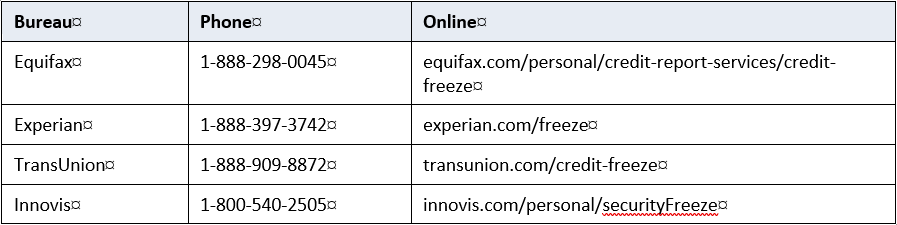
You will need your name, address (and prior addresses from the last two years), date of birth, and Social Security number. Once placed, each bureau will confirm by email or letter. Record your login credentials (and the Innovis PIN) in a password manager — you will need them to lift the freeze. By law, online and phone freeze requests must be in place within one business day; mailed requests within three.
Innovis and the "Secondary" Bureaus
Innovis is the fourth bureau most people miss. Beyond it, a handful of specialty agencies are used by banks, utilities, phone carriers, and insurers, and can each be frozen for free:
ChexSystems (bank and credit union account openings) — chexsystems.com
NCTUE (telecom and utility accounts) — nctue.com
LexisNexis (insurance and financial verification) — consumer.risk.lexisnexis.com
For most clients, freezing the four main bureaus is the essential step. For those who have already been victims, or whose profile makes them a likely target, closing these additional doors is worthwhile.
How to lift a freeze
A freeze remains until you ask the bureau to lift it temporarily or remove it permanently. Log in to your account (or call), choose the bureau the lender uses, and select a date range. Online and phone lifts must take effect within one hour; mailed requests within three business days. All of this is free.
Beyond the freeze: Closing the other doors
Credit is only one of the places an identity can be misused. We also suggest:
Get an IRS Identity Protection PIN (irs.gov/ippin). It prevents anyone from filing a tax return in your name — a fraud that has hit several high-profile individuals.
Claim your Social Security account at ssa.gov/myaccount before someone else does, and consider blocking electronic access to your record.
Opt out of pre-screened credit offers at optoutprescreen.com (1-888-567-8688). Fewer offers in the mailbox means fewer for a thief to intercept.
Enable USPS Informed Delivery (informeddelivery.usps.com) so you see what mail is coming — and so no one else can enroll in your name.
Use a password manager and two-factor authentication on every financial account, and a unique email address for banking that you do not use elsewhere.
Ask your custodians and banks about verbal passwords and callback procedures for wire and distribution requests. Social engineering of front-line staff is now the most common vector for large-dollar theft.
Limit your public footprint. Data-broker removal services (or manual opt-outs) reduce how much of your address, phone, and family information is available to anyone who looks.
If you believe you are already a victim, start at IdentityTheft.gov, the FTC's one-stop site for an official report and a recovery plan.
Feel free to share this with your friends and family, your children and your grandchildren. We cannot necessarily prevent cybercrime, but we can make it much more difficult — and much less rewarding — for the cybercriminals.

Alternative Investment Management, L.L.C. 777 Third Avenue, 30th FL New York, NY 10017
www.aim13.com | (212) 557-6191
This memo is provided for general informational purposes and does not constitute legal, tax, or personalized financial advice. Contact information and procedures are current as of August 2026 and may change; please verify with each bureau directly.