AIM13 Commentary - 2026 Q2
“You see us as you want to see us,
in the simplest terms, in the most convenient definitions.”
The old saying about seeing no evil and hearing no evil describes willful ignorance, and across the markets we watch, we are seeing exactly that: elevated valuations dismissed as “this time it’s different,” bond market risks treated as background noise, and economic warnings waved away because the trend of “up and to the right” has held so far. There is a huge Fear of Missing Out. However, complacency is not a strategy, and patience is not the same as inaction. As we discuss more below, we believe the disciplined path forward is not to look away from these risks, but to see them as they are. It also means having the conviction to wait for the right pitch rather than chase a market that has thrown caution to the wind.
The second quarter saw some of the strongest returns in our 27-year history for the managers we focus on, but to be honest, we spent about ten seconds thinking about it. We could have taken more risk, but our focus has been taking chips off the table rather than doubling down. In the short term, these moves may not be the right answer, but we try to remain disciplined and focused, and not let recent performance cloud our judgment. As we said in last quarter’s letter, we have not lost sight of the downside and the power of negative numbers, our illustration of which is included in this and every quarterly letter we write to our partners in our hedgeD strategies.
In private equity, the biggest story is the lack of DPI – distributions to paid in capital – driven by managers holding onto companies longer than ever before.That headline, however, belies our experience. Given our focus on the smaller end of the private equity market, we have seen companies exit to larger funds and strategics at a faster pace than we have seen in years.
* * *
“Don’t ask the barber whether you need a haircut.”
There are tons of reasons to be cautious in the current environment. Elevated valuations, deal flow accelerating, debt markets shaky – yet the pressure to keep pace is only getting worse. There are opportunities worth pursuing, but everyone needs to be honest with themselves that the primary psychology of the moment is the Fear of Missing Out. FOMO rarely announces itself; it shows up as urgency, as “If I don’t do this deal, I’ll regret it,” and as the pressure to match what everyone else is doing – even when your gut tells you something is just not right. In its worst form, it comes from the asset manager or broker who stands to gain by you pulling the trigger on a trade or a deal, the proverbial barber selling you the need for a haircut.
We have raised the bar for new investments and definitely are not lowering our guard. Discipline is easy to talk about in calm or difficult markets, but hard to practice in hot ones. The moments that test caution most are exactly the moments it costs the most to hold. However, we would rather answer for the deals we passed on than the ones we should not have done.
“Good things may come to those who wait, but only the things left by those who hustle.”
Discipline and patience should not be confused with inaction. Ken Griffin rarely rests on his laurels, and what he did with Situational Awareness in August is a textbook example of him and his team out-working their peers. For us, we have never been busier, and we are doing a lot of work on the hedge fund portfolio to manage risk, which is first and foremost on our minds. Our dealflow is also as strong as ever, so that means working overtime to find the one in the hundred that we see that is worth pursuing.
Our pace may look conservative next to the broader market at times, and we are fine with that. Our job is not to maximize activity. If we need to wait for an opportunity, we are willing to do that. That means sitting out when the speculation outweighs realism, no matter how good the story sounds. The best opportunities rarely come with the splashiest headline.
We try our best to stay disciplined, even when it is uncomfortable. Our priority is to protect and compound our capital and our partners’ capital over time with superior, risk-adjusted returns. Alignment of interest is critical in all of our investments, with our managers and with ourselves.
Market Observation
“It’s possible something’s baked in, but what’s not baked in is what actually happens.”
This recent observation from Jamie Dimon reminds us of Donald Rumsfeld’s “unknown unknowns” from February 2002 and is in line with our concern about investor complacency. The reality is that we have no clue where the next crisis will arise and what its impact will be on investments. However, a few things that are observable certainly make us concerned:
Consumer debt continues to climb: According to the New York Federal Reserve, total household debt in the U.S. hit a record $18 trillion in the first quarter of this year. A component of this, credit card balances, is also hovering at all time highs:
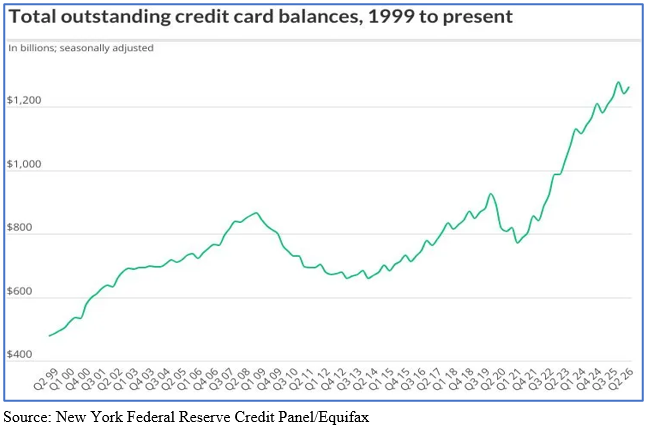
Borrowing costs remain steep, with the average APR on interest-accruing cards at 22.15% in Q2 2026, up from 21.52% the prior quarter. One concern (among many) is increasingly concentrated among younger and subprime borrowers with fewer financial buffers, indicating more “survival borrowing” rather than discretionary spending.
Notably, the 60-day delinquency rate on subprime auto loans has climbed to 6.9%, according to new data from Fitch Ratings and Equifax released in August. This exceeds the 2008 financial crisis peak of 5.0% and the 1996 high of 6.0%, and is the highest reading in Fitch’s entire history, which dates back to the early 1990’s. If wage growth stalls or unemployment rises, the consumer debt overhang could force a sharper-than-expected pullback in spending, even as aggregate household-debt data currently looks “stabilized” rather than alarming.
IPO market heats up: When we read in June in the Wall Street Journal that a 140-year-old idle silver mine in Idaho that had gone bankrupt went public and raised $270mm at a $1.9 billion valuation, we knew the IPO market is back. We have been the beneficiary of IPO market in our private equity portfolio, though that does not stop us from scratching our heads at just how fast the market has rebounded:
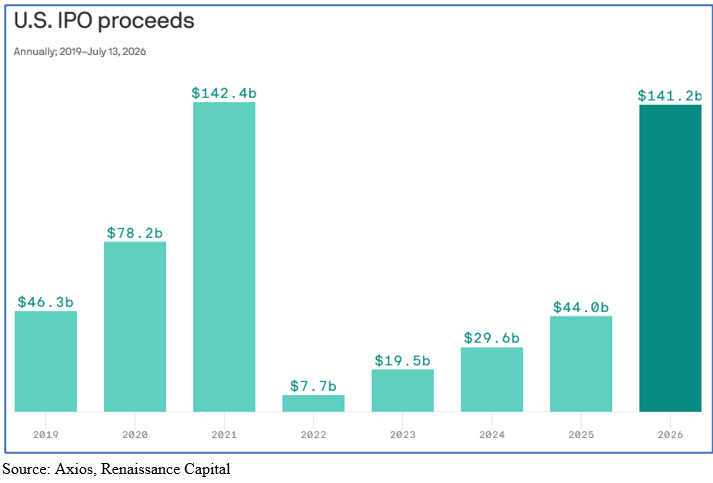
To be clear, a lot of this volume can be attributed to a small handful of companies like SpaceX ($75B raised) and SK Hynix ($26.5B raised), though with companies like Anthropic, OpenAI, Anduril, and Stripe still in the wings, 2026 stands to be one of the largest IPO years on record. Hot IPO markets often coincide with periods of “over exuberance.” We see a market willing to absorb mega-deals at rich valuations as another signal of complacency about downside risk.
Public sentiment hits record low – as NASDAQ hits record high. On June 2, 2026, the NASDAQ Composite Index hit a record high, just a few weeks following a new record low in consumer sentiment since the University of Michigan started tracking the data in 1952:
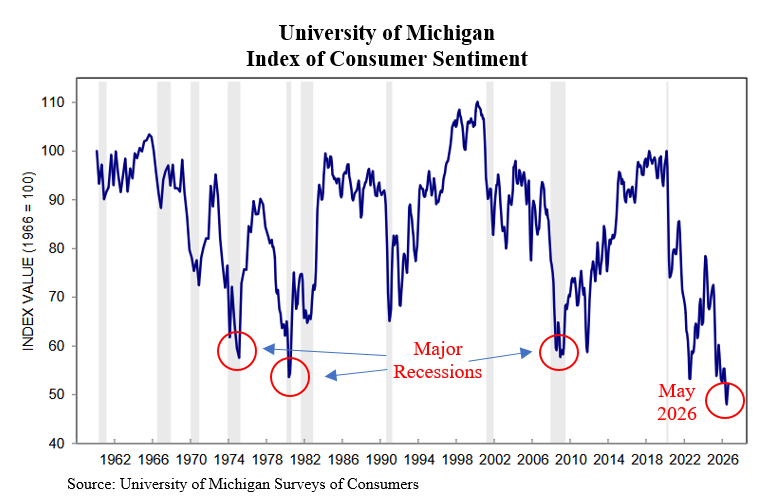
The dichotomy is striking and one more indication of a bifurcation in society that should be troubling for any good citizen, investor or not. The general public is weighed down by inflation in the form of rising housing costs, gas prices, etc., by political discord, and by tensions here and abroad. Yet at the very same time, public market investors are notching new highs in their portfolios. We are skeptical that this “tale of two cities” can be sustained for long.
* * *
New offices
Please note that we have moved our offices, just one block north, to 777 Third Avenue, 30th Floor, New York, New York 10017.
Sincerely,
Alternative Investment Management, LLC (AIM13)